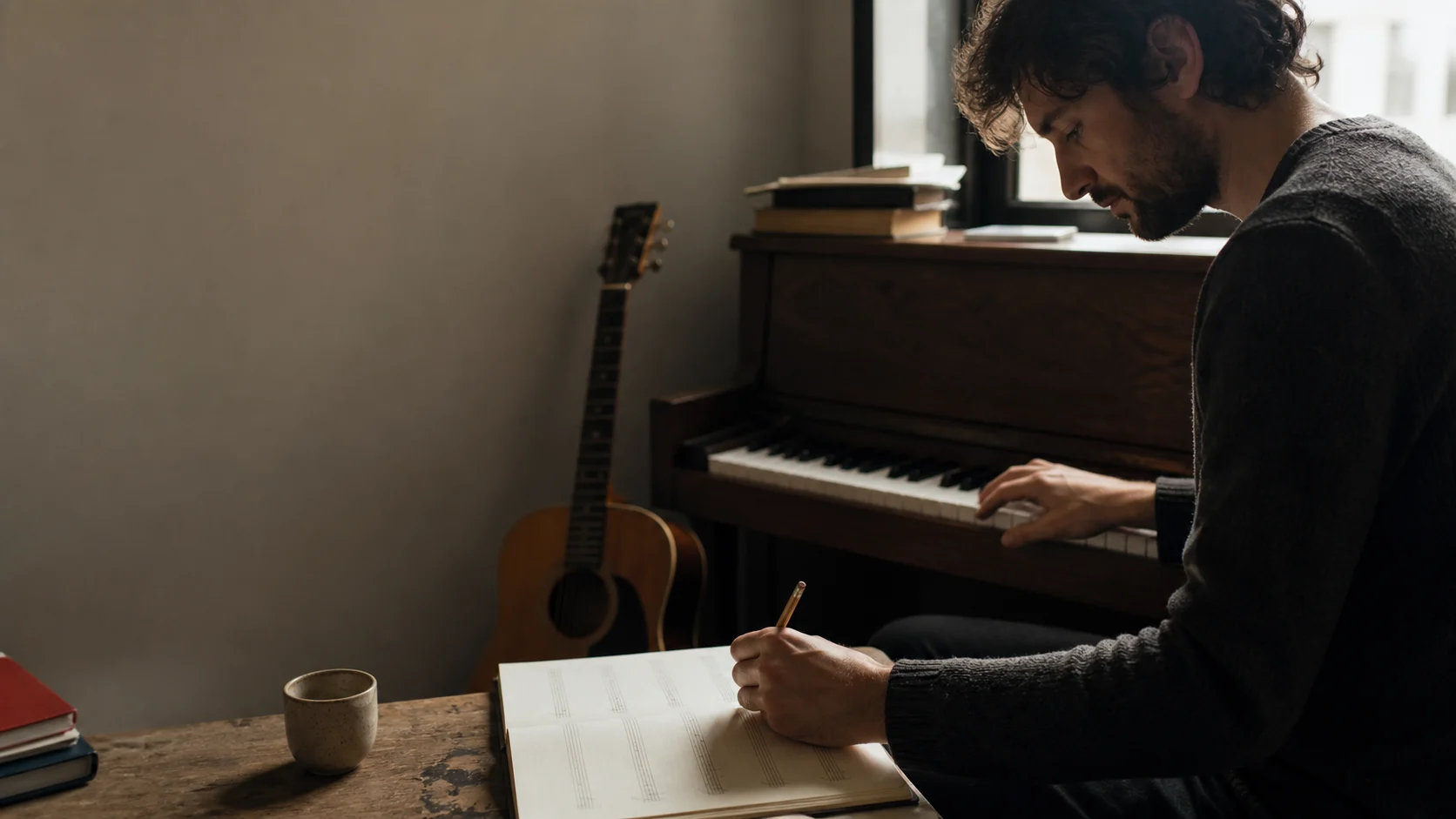
Most songwriters don't practice songwriting. They practice guitar. They practice singing. They practice piano. But the actual craft of writing, rhyme selection, prosody, imagery, structure, goes unpracticed. They write when inspiration strikes and hope for the best.
This is like a basketball player only practicing during games. It doesn't work.
A routine does not need to imitate anyone else's schedule. Its job is simpler: make one craft decision repeatable enough that you can notice what changes from draft to draft.
Here's a 20-minute daily routine you can start today:
Minutes 1-5 · Object Writing
Pick a random object (coffee, doorknob, rain). Write about it using all your senses: sight, sound, taste, touch, smell, body sensation, movement. Don't try to be poetic. Just dump sensory details. This builds your imagery vocabulary.
Minutes 5-10 · Rhyme Sprint
Pick a word. Generate as many rhymes as you can in 60 seconds: perfect rhymes, family rhymes, assonance, consonance. Then pick your favorite and write a two-line couplet. This builds fluency with your most important songwriting tool.
Minutes 10-15 · Rewrite Exercise
Take a line from one of your existing songs (or a famous song). Rewrite it three different ways: once with more specific imagery, once with a different rhyme type, and once from a different point of view. This builds your revision muscle.
Minutes 15-20 · Free Write
Write a verse or chorus. Use whatever technique you just practiced. Don't judge it. Just write. The goal is output, not perfection.
The useful variable is consistency, not a heroic duration. Twenty minutes is a workable example; five focused minutes still counts. Repetition gives you comparable attempts, which makes your defaults easier to hear and revise.
After a run of sessions, review the pages instead of assuming improvement. Look for more specific images, a wider rhyme palette, or one prosody mismatch you can now name. Keep the routine only if the evidence in your drafts supports it.